
Tennessee Uses Circuit Court, Not District Court
Tennessee does not use "District Court" as the name for its main county trial court. Some states do, but the Tennessee structure splits trial work between Circuit Courts and Chancery Courts, with General Sessions and Juvenile courts handling lower and specialized jurisdiction. A reader from another state may expect to see a "Williamson County District Court," but the right term here is Circuit Court for the law side and Chancery Court for the equity side. The 21st Judicial District is a district label that groups the counties, not the name of a county court.
This matters because the wrong term sends people to the wrong office. If you came expecting a District Court, you most likely want Circuit Court for a felony or larger civil matter, General Sessions for a misdemeanor or small civil claim, or Chancery for probate or equity. Picking the right court at the start saves a wasted call. The "21st Judicial District" label is also not the same as a county court; it groups counties for prosecution and judge assignments, not for record searches.
Williamson County Circuit Court Overview
Circuit Court is a trial court of record. It hears felony criminal cases, major civil matters, domestic relations, and appeals from General Sessions. Judges are elected to eight-year terms. The Circuit Court Clerk is the public-facing records office for Circuit Court, General Sessions Court, and Juvenile Court. The courthouse for Circuit Court business is the Williamson County Judicial Center in downtown Franklin.
A criminal case can start in General Sessions, often with a warrant and a preliminary hearing, and then move to Circuit Court if a grand jury returns an indictment. A civil case can also move by appeal from General Sessions to Circuit Court. The Circuit Court Clerk keeps the case file under the new number once that transfer happens, which is one reason a clerk request needs the current case number.
Tennessee's 95 counties are grouped into 32 judicial districts. Within each district sit Circuit and Chancery courts, as the state constitution provides. Some judicial districts also have legislatively created Criminal Courts or Probate Courts. Williamson County does not have a separately created county criminal court or a separately named probate court, so felony work runs through Circuit Court and probate runs through Chancery Court. Judges of these trial courts are elected to eight-year terms, and elections matter because the same judges hear the everyday docket year after year.
Chancery Court and the Clerk and Master
Chancery Court is a separate trial court of record in Tennessee, focused on equity work. In Williamson County, Chancery Court handles probate, estates, conservatorships, guardianships, trusts, injunctions, declaratory judgments, contract disputes, and other equity matters. The clerk for Chancery Court is the Clerk and Master, a Tennessee-specific office that does not exist in most other states.
The Clerk and Master is the right office for probate filings, estate questions, and equity cases. The probate records page explains the estate filing process and what the Clerk and Master keeps. The two clerks, Circuit and Master, work alongside each other in the Judicial Center and serve different courts.
General Sessions Court
General Sessions Court is the high-volume limited court in Tennessee. It hears misdemeanors, preliminary criminal hearings, traffic, civil warrants, detainers, and smaller civil claims. Every Tennessee county has a General Sessions court, and the jurisdiction can vary by county under state law and private acts. In Williamson County, General Sessions runs through the same Circuit Court Clerk that supports Circuit Court.
The fast pace matters. Settings move quickly, dates can reset often, and a missed date can produce a capias. For traffic and small civil cases that may start here, the traffic court records page and the court dockets page cover what to expect.
Juvenile Court
Juvenile Court handles delinquency, dependency and neglect, juvenile custody, and related youth matters. Tennessee has 98 juvenile courts, 109 juvenile court judges, and 45 magistrates statewide. Of those, 17 are designated Private Act juvenile courts and 81 are General Sessions courts with juvenile jurisdiction. Juvenile records are restricted under Tennessee law, so this court is not a place for ordinary public-record browsing.
For Williamson County, Juvenile Court matters are part of the local court system but require a legal reason to access most files. Parties, counsel, agencies, and people with court authorization may see records the public cannot.
Municipal Courts in Williamson County
Municipal courts are city courts. They handle city ordinance violations and municipal traffic matters. In Williamson County, cities such as Franklin, Brentwood, Fairview, Nolensville, Spring Hill, and Thompson's Station may operate their own municipal courts, with clerks separate from the county. A city ticket is not in the county General Sessions system, and a request to the county clerk for a city case will likely get pointed back to the city.
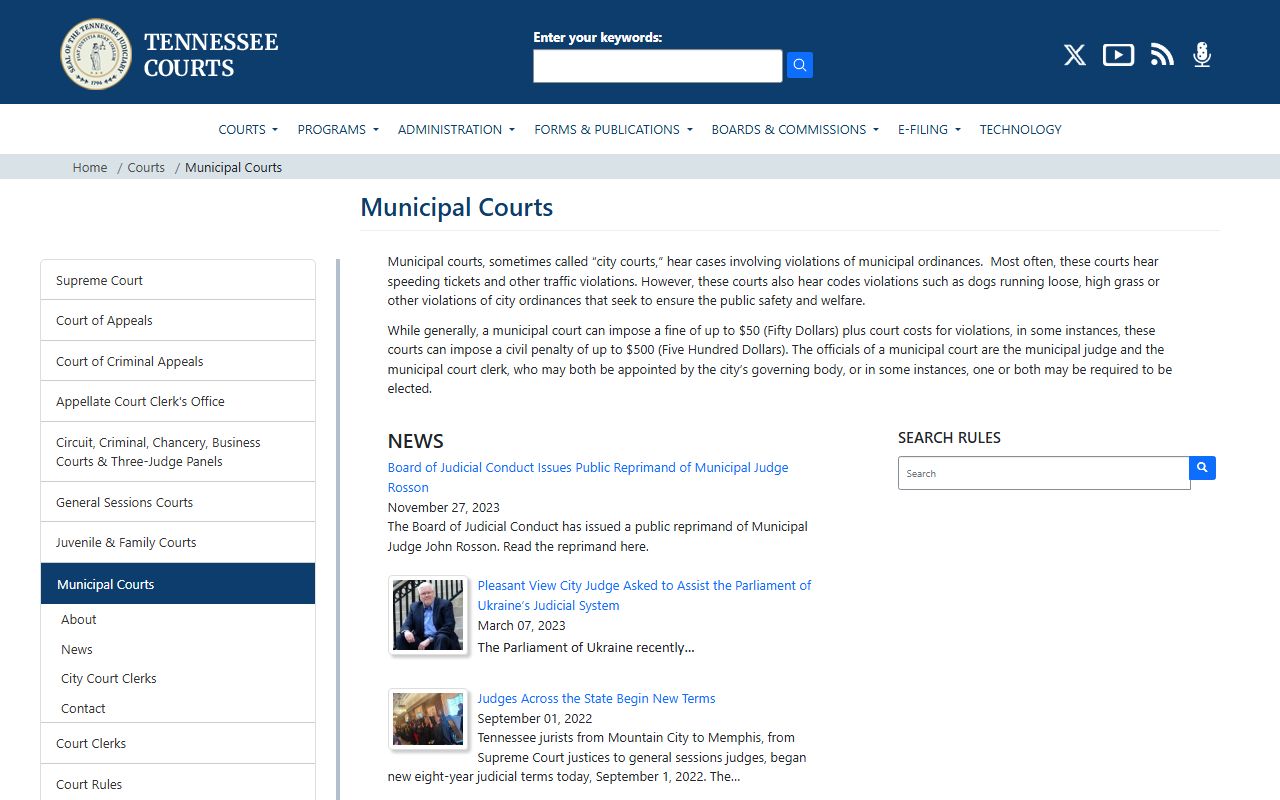
The state explains the role of these courts on the Tennessee AOC municipal courts page. The city named on the citation tells you which municipal court holds the case.
Tennessee Trial Courts Comparison
The four primary trial courts in Williamson County play different roles. The comparison below highlights how they differ at a glance, which is useful when you are not sure which court holds a case.
| Court | Type | Main Case Types | Local Address |
|---|---|---|---|
| Circuit Court | Trial court of record | Felony, major civil, domestic, appeals from General Sessions | Judicial Center, 135 4th Avenue South, Franklin, TN 37064 |
| Chancery Court | Trial court of record | Probate, equity, trusts, conservatorship, guardianship | Judicial Center, 135 4th Avenue South, Franklin, TN 37064 |
| General Sessions Court | Limited jurisdiction | Misdemeanor, preliminary criminal, traffic, civil warrants, detainers | Judicial Center, 135 4th Avenue South, Franklin, TN 37064 |
| Juvenile Court | Limited and confidential | Delinquency, dependency and neglect, juvenile custody | Judicial Center, 135 4th Avenue South, Franklin, TN 37064 |
City municipal courts sit outside this table and use city-specific locations. Federal cases sit in federal court, not any county trial court.
The 21st Judicial District
Williamson County is part of Tennessee's 21st Judicial District, along with Hickman, Lewis, and Perry counties. The district label groups the counties for the District Attorney General, the public defender system, and trial-judge assignments. It is not a local district court. The District Attorney prosecutes state criminal cases across the four counties and handles felony prosecutions in Circuit Court, plus misdemeanor and preliminary matters in General Sessions.
Federal cases in this region sit in the U.S. District Court for the Middle District of Tennessee. The U.S. Attorney's Office for that district prosecutes federal crimes that arise in Williamson County.
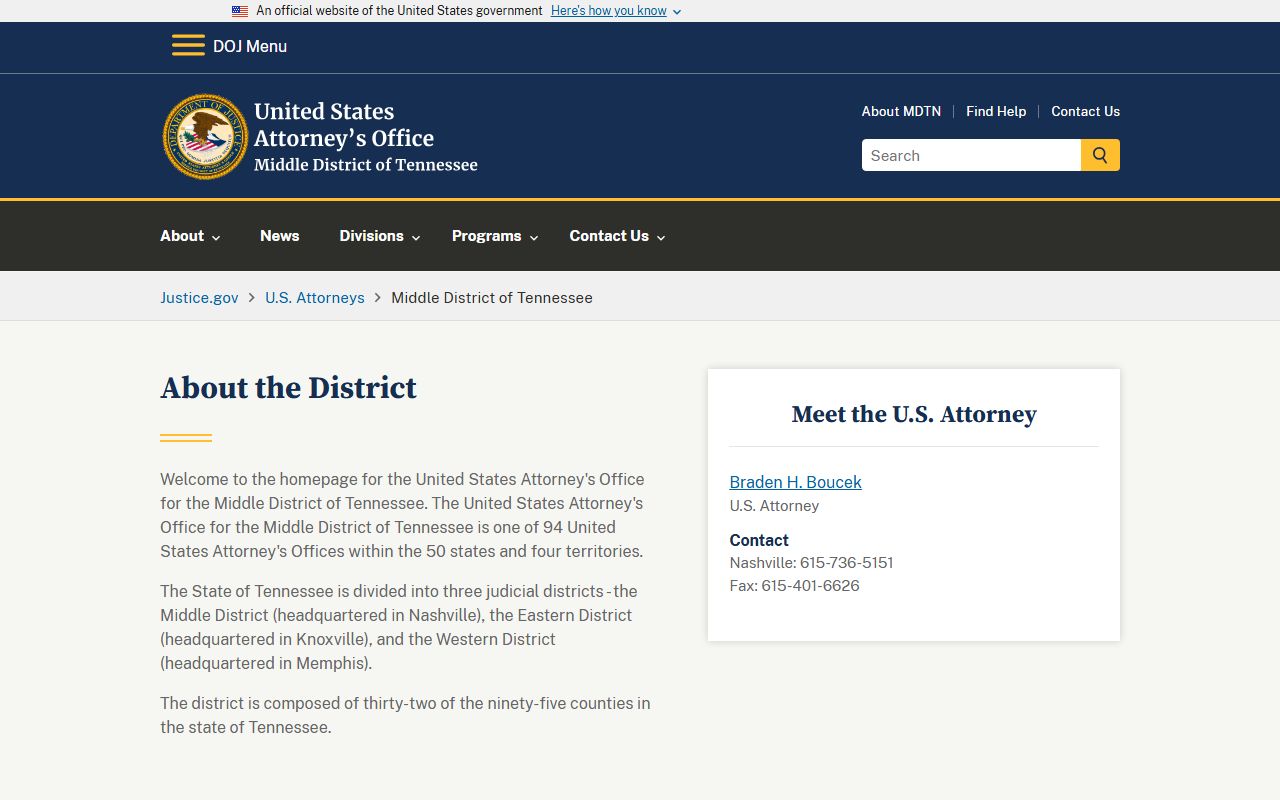
The U.S. Attorney's Office for the Middle District of Tennessee handles federal prosecutions in this region. A federal case is not searched through any Williamson County clerk; it is searched through PACER.
Appellate Path
Appeals from Williamson County trial courts move up the state appellate ladder. Civil appeals go to the Tennessee Court of Appeals. Criminal appeals go to the Tennessee Court of Criminal Appeals. Discretionary review sits with the Tennessee Supreme Court, which is the court of last resort and also sets the rules that control how trial courts run.
For appellate dockets, the state publishes a searchable Public Case History portal. Trial-court files stay with the local clerk, while appellate docket information is available online. Pairing the two gives the full picture of a case that moved on appeal.
How a Williamson County Case Moves Through the System
A criminal case often starts with an arrest or warrant. It moves to General Sessions for a preliminary hearing. If a grand jury indicts, it moves to Circuit Court for trial. After judgment, an appeal can move it to the Court of Criminal Appeals, and then by petition to the Supreme Court.
Case flow: General Sessions Court › Circuit Court › Court of Appeals or Court of Criminal Appeals › Tennessee Supreme Court
A civil case often starts with a complaint in General Sessions or Circuit Court depending on the amount and the type. Probate runs through Chancery Court and the Clerk and Master. Appeals from civil judgments move to the Court of Appeals. The flow is not one path for every case, but the basic ladder helps you predict where a file will live as it ages.
For records access at each level, see the court records page and the Circuit Court Clerk page. For marriage and county-clerk records, see the County Clerk page. The court dockets page covers how to check the next hearing date in any of these courts.