
How to Search Williamson County Court Records
There is no single search box for every Williamson County Court case. Records are split across offices, so the smart first move is to name the case type, find the court that holds it, then go to the right clerk. Circuit, General Sessions, and Juvenile records run through the Circuit Court Clerk. Chancery and probate records run through the Clerk and Master. Marriage records sit with the County Clerk. Knowing this split saves time and a lot of dead-end calls.
Before you start, pull together the basic facts. You will move faster with the party names, the rough filing year, the case type, and the case number if you have it. A clear request is easier for any clerk to answer.
- Identify the record type and the court that handles it, using the case-type list below.
- For appellate matters, search the Tennessee appellate Public Case History portal by party name or case number.
- For trial-court files, contact the Circuit Court Clerk or the Clerk and Master that maintains the record.
- Give the clerk the names, filing year, case type, and case number, and say whether you want a docket check, inspection, or copy.
- Ask for a certified copy if you need the record for legal use, and confirm the current fee before you pay.
The Williamson County government site is the best starting hub for the local court offices and their contact pages. You can reach the court departments from the official Williamson County website, which links each court division and clerk.

That county hub points users to the Court System section, where the trial courts and clerks are grouped. Use it to confirm a department before you call, since contact details change over time.
Most public, day-to-day clerk work for Circuit, General Sessions, and Juvenile cases flows through one office. The Williamson County Circuit Court Clerk page describes those clerk services and is the right landing spot for many case searches.
The Circuit Court Clerk supports filing, docketing, fee collection, and counter access for three courts at once. That is why it is the first stop for criminal, civil, domestic, and General Sessions record questions.
The Williamson County Judicial System
Williamson County sits inside Tennessee's 21st Judicial District, along with Hickman, Lewis, and Perry counties. The state splits its trial work between law courts and equity courts. Circuit Court handles law, criminal, and domestic cases. Chancery Court handles equity, probate, trusts, conservatorships, and guardianships. General Sessions Court is the high-volume limited court for misdemeanors, traffic, civil warrants, and detainers. Juvenile Court is a separate, confidential jurisdiction for youth and dependency matters.
Tennessee's 95 counties are grouped into 32 judicial districts. Within each district sit Circuit and Chancery courts, and every county has a General Sessions court. Trial courts of record matter most for long-term records because they create the pleadings, orders, and judgments that can be appealed. Appeals from Williamson County go to the Court of Appeals for civil cases and the Court of Criminal Appeals for criminal cases, with final review by the state Supreme Court.
Case flow: General Sessions Court › Circuit Court › Court of Appeals or Court of Criminal Appeals › Tennessee Supreme Court
The Williamson County Court System page maps each division in one place, which helps when you are not sure where a case lives. You can view the local divisions on the county Court System landing page.
That same page is a good check before a courthouse trip, since it confirms which clerk supports which court. The table below shows how the levels stack up.
| Court | Jurisdiction | Case Types |
|---|---|---|
| Tennessee Supreme Court | Court of last resort | Discretionary review, court rules, attorney discipline |
| Court of Appeals / Court of Criminal Appeals | Intermediate appellate | Civil appeals; criminal appeals |
| Circuit Court | Trial court of record | Felony, major civil, domestic relations, appeals from General Sessions |
| Chancery Court | Trial court of record (equity) | Probate, estates, trusts, conservatorship, guardianship, injunctions |
| General Sessions Court | Limited jurisdiction | Misdemeanor, preliminary criminal, traffic, civil warrants, detainers |
| Juvenile Court | Limited, confidential | Delinquency, dependency and neglect, juvenile custody |
The state's Administrative Office of the Courts explains this structure for all 95 counties. Its overview of the court system is on the Tennessee AOC courts page.
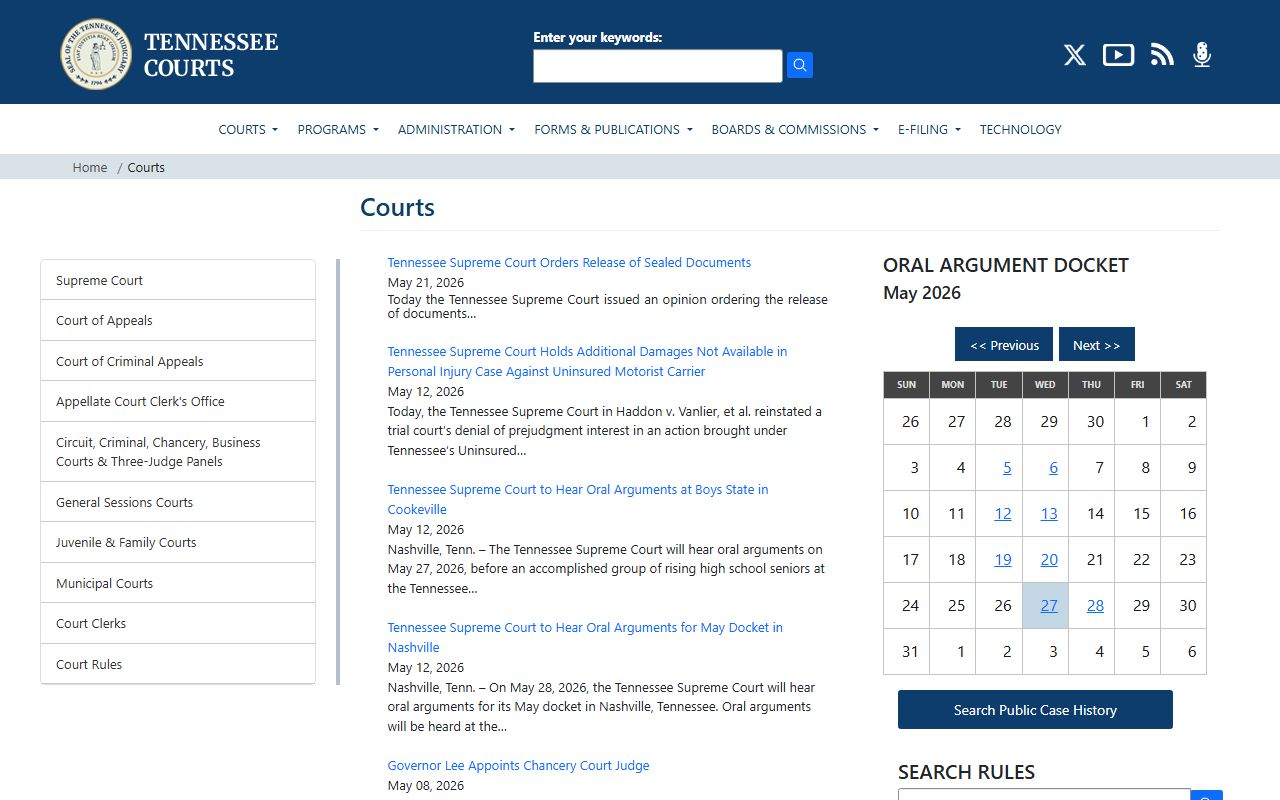
Reading the state overview alongside the county pages clears up a common mix-up. Tennessee does not run a county-level District Court the way some other states do.
Williamson County Courthouses
The main court-record destination is the Williamson County Judicial Center in downtown Franklin. It houses Circuit Court, Chancery Court, General Sessions Court, Juvenile Court, the Circuit Court Clerk, and the Clerk and Master. The historic courthouse on the square is a landmark, but the Judicial Center is where the clerk filings, hearings, payments, and record services happen. The Sheriff's Office and jail sit at a separate address.
Criminal Justice Center
408 Century Court
Franklin, TN 37064
615-790-5560
Types of Court Records Available in Williamson County
Williamson County Court records fall into a handful of broad groups. Each group is tied to a court, and each court keeps its own files. Most adult civil and criminal records are public unless a statute or court order limits them. Juvenile and a few sensitive categories are restricted from the start.
Which court produces a record tells you where to search. General Sessions starts most traffic and misdemeanor cases. Circuit Court takes felonies and larger civil suits. Chancery Court, through the Clerk and Master, holds estate and equity files.
- Criminal records - warrants, indictments, pleas, judgments, and sentencing orders from General Sessions and Circuit Court.
- Civil records - complaints, answers, motions, judgments, plus General Sessions civil warrants and detainers.
- Family and divorce records - divorce complaints, parenting plans, support orders, and final decrees.
- Probate records - wills, letters, inventories, and guardianship or conservatorship files held by the Clerk and Master.
- Traffic records - citations, court dates, fines, and dispositions, often in General Sessions or a city court.
One common point of confusion is the split between General Sessions and Circuit Court. The comparison below shows how they differ, since a single criminal case can begin in one and end in the other.
| Feature | General Sessions Court | Circuit Court |
|---|---|---|
| Criminal reach | Misdemeanors and preliminary hearings | Felony prosecution after bind-over |
| Civil reach | Smaller claims, civil warrants, detainers | Major civil suits and appeals from General Sessions |
| Record of | High-volume, fast-moving cases | Indicted felonies, divorces, large judgments |
| Clerk | Circuit Court Clerk | Circuit Court Clerk |
You can read more on the Williamson County court records page and check the related court dockets for scheduling detail.
What Williamson County Court Records Show
A Williamson County court record is built from standard fields. The exact look depends on the court and the case type, but the core data is consistent. A docket shows the case identity and the chain of events. A full file adds the actual documents, where they are public. The table walks through the fields you are most likely to see.
| Field | What It Shows |
|---|---|
| Case Number | The clerk's unique ID for the case; cite it exactly in every request. |
| Filing Date | When the case began in that court, not always the arrest or incident date. |
| Parties | Plaintiff and defendant, State and defendant, or petitioner and respondent. |
| Charges / Cause | The criminal charges or the civil claim that started the case. |
| Disposition | The final result for a charge or claim, such as dismissed, guilty, or settled. |
| Sentence / Judgment | The enforceable order: jail, probation, fines, or a money judgment. |
Some fields are removed from public copies. Social Security numbers, bank account numbers, full birth dates, and minor names are redacted. Sealed exhibits stay out of view. For federal matters tied to the county, the free CourtListener mirror can help, though the official source is the federal court.
Federal cases that arise in Williamson County are not in the county clerk system at all. They sit in the U.S. District Court for the Middle District of Tennessee and are searched through PACER.
Public Access Laws for Williamson County Court Records
Public access in Williamson County rests on a few sources. The Tennessee Public Records Act gives citizens a right to inspect records unless a statute makes them confidential. Court records add their own layer through Tennessee Supreme Court Rule 34. A case can be public at the docket level while certain documents are sealed or redacted. County administrative records go through a public-records request; court files go through the clerk that holds them.
Rule 34 is the central court-record access rule, and the state publishes it in full. You can read it on the Tennessee courts site, which lays out what counts as a court record and when access is limited.
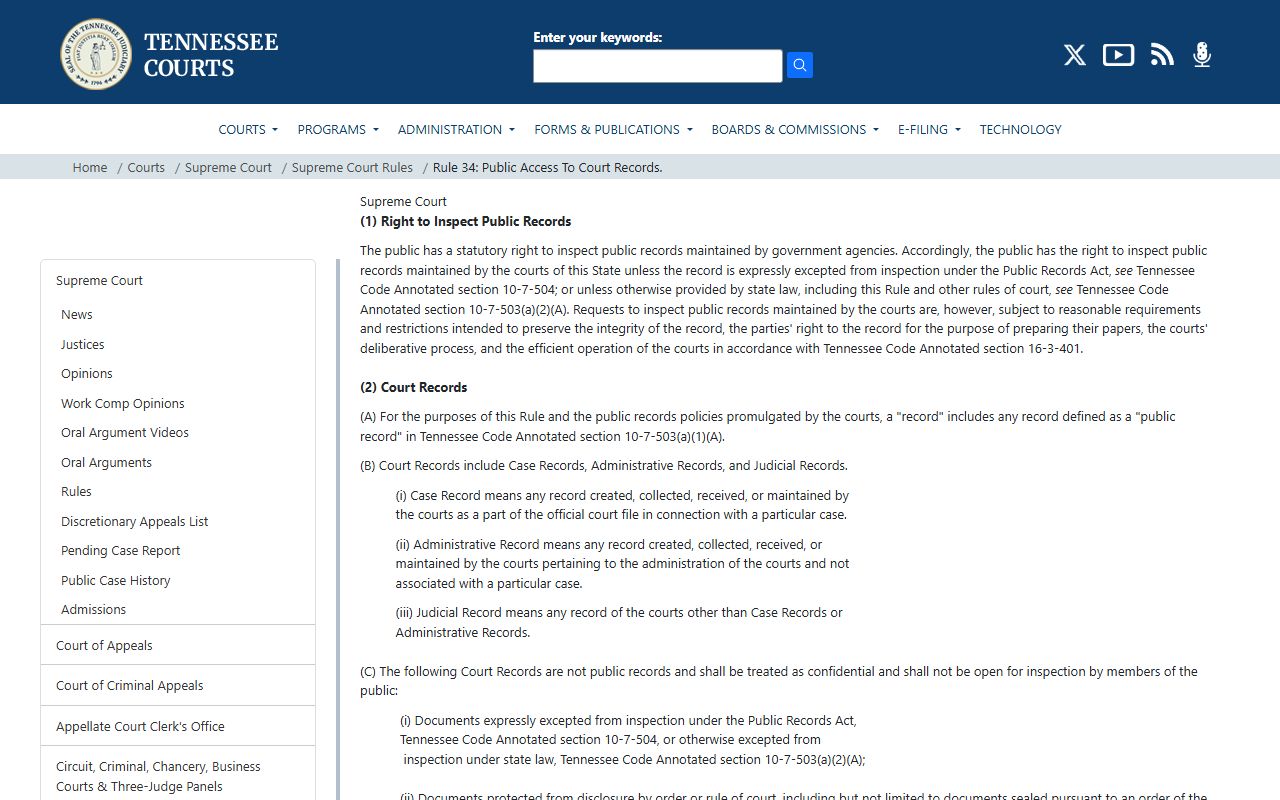
The rule shown there explains exclusions and the steps to limit access, which is why some filings never appear online. The key statutes are gathered below.
Key Statutes:
Tennessee Code § 10-7-503 - gives the public the right to inspect open records held by a state or county office.
Tennessee Code § 10-7-504 - lists records that are confidential, such as some medical, security, and personal data.
Tennessee Code § 10-7-506 - lets offices set reasonable charges for copies and the labor to produce them.
Tennessee Supreme Court Rule 34 - controls public access to court records and the process for sealing.
Tennessee Code § 37-1-153 - keeps juvenile court records confidential except as the law allows.
Records That Are Restricted or Confidential
Not every Williamson County court record is open. Juvenile, adoption, mental-health, sealed, and expunged records are confidential or limited. Grand jury proceedings stay secret. Protective-order files may hide victim addresses and contact details. A public docket entry does not promise access to the document behind it. When a record is confidential by statute, the clerk cannot release it just because someone asks.
To view a sealed record, a person usually must file a motion in the court that sealed it and show a legal reason for access. The judge decides. Expunction works the other way: under state law, a court order can remove eligible records from public systems. After the order, the clerk sends it to agencies that hold copies, including the sheriff, the court, and the prosecutor. Anyone unsure about eligibility should check the statute and talk to a lawyer.
Specialty Courts in Williamson County
Williamson County and the 21st Judicial District take part in Tennessee's problem-solving court programs. These courts handle eligible defendants outside the normal track, with judicial monitoring, treatment, and regular reviews. Admission is screening-based, not automatic, and a prosecutor and judge must approve it.
A recovery or drug court works with people whose cases tie to substance use. Participants get treatment, testing, case management, sanctions, and incentives. A veterans treatment court, where offered, links justice-involved veterans with treatment, mentoring, and Veterans Affairs resources. Mental health tracks may add counseling, medication support, and intensive supervision. Court files for these programs may show admission and status events, but the clinical details stay confidential. Check current Tennessee AOC problem-solving court directories for the exact local program names before relying on a specific court.
Williamson County Sheriff and Jail
The Williamson County Sheriff's Office runs the county jail, the John I. Easley Jr. Criminal Justice Center. The facility is about 121,000 square feet, sits on 19 acres, and holds 454 beds for pre-trial and sentenced individuals. Sheriff Jeff Hughes leads the office. Booking, classification, and inmate records are handled inside the Detention Division. The office did not publish a searchable public jail roster in the sources reviewed, so current custody is best confirmed by phone.
For the full custody and visitation picture, see the Williamson County inmate records page, and check warrant records for how active warrants are verified. To track a release, the released inmates page covers VINELink and state options.
Marriage, Divorce, and Probate Records
Marriage licenses are a County Clerk function in Williamson County. Divorce cases are filed with the court and run through the Circuit Court Clerk. Probate, estates, and guardianships are Chancery Court matters handled by the Clerk and Master. See the marriage and divorce records page and the probate records page for the full process. A few probate terms come up again and again.
- Testator
- The person who made a will.
- Executor
- The person named in a will to settle the estate.
- Intestate
- Dying without a valid will, so state law sets the heirs.
- Conservator
- A person the court appoints to manage an incapacitated adult's affairs.
Williamson County Court Records Fees
Clerks may charge for copies and for the work to produce them. State law allows reasonable charges, but the exact amounts come from each clerk's current schedule. A current official Williamson County fee table was not located in the sources reviewed, so confirm amounts with the clerk before you pay. The table lists the common fee types rather than invented prices.
| Item | What It Covers |
|---|---|
| Plain copy | An uncertified copy of a page in the file; amount set by the clerk's schedule. |
| Certified copy | A copy the clerk certifies for legal use; costs more than a plain copy. |
| Certification fee | The clerk's charge to certify a document; confirm the current rate. |
| Records search / retrieval | Possible charge for staff time to pull archived or paper files. |
Court costs and fines are a separate matter from copy fees. State law on criminal costs and enforcement is set out in Tennessee Code § 40-24-105, which county pages use to explain court financial records.
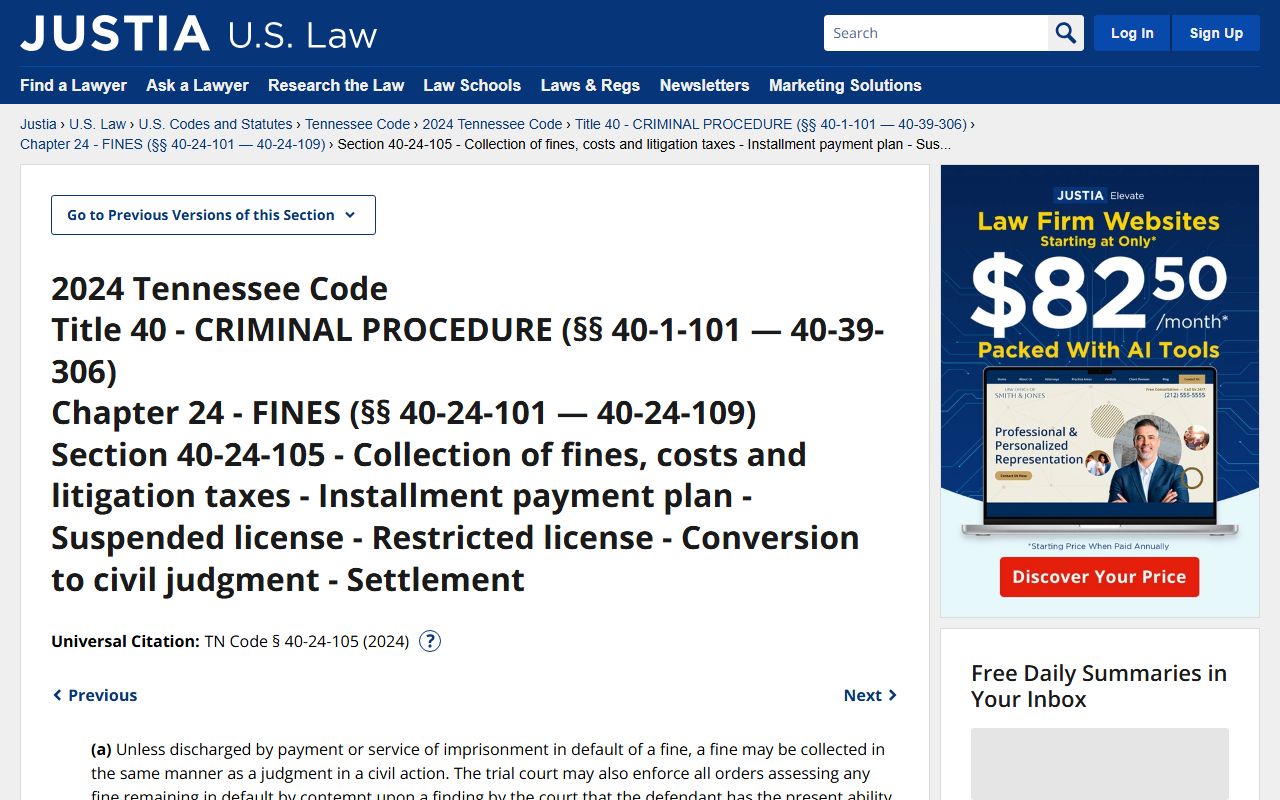
Those costs can stay on a case after the substantive matter is closed. That is why a disposed case may still show an open balance.
How to Interpret Williamson County Court Records
Court records use shorthand that can mislead a first-time reader. A charge is not a conviction. A disposition is the final result, while the status line is only a snapshot. Read the docket events from oldest to newest to follow the case story, and newest to oldest to find the next deadline. A judgment is the enforceable order, not just any entry.
Watch the difference between custody and court data, too. A booking record shows jail processing. A court record shows charges, hearings, and orders. They can look different for the same person. When something is unclear, the clerk can explain a code or an entry, but a clerk cannot give legal advice.
Accuracy and Record Limitations
Online court data can lag behind the paper file. New filings, dispositions, and corrections take time to post. Older cases may be paper, microfilm, or archived and not in any electronic index. Because no universal public trial-court portal for Williamson County was located, even recent records may need a clerk contact. The appellate Public Case History portal is the one searchable state system, and it covers appellate cases, not local trial files. You can reach it through the Tennessee appellate Public Case History portal.
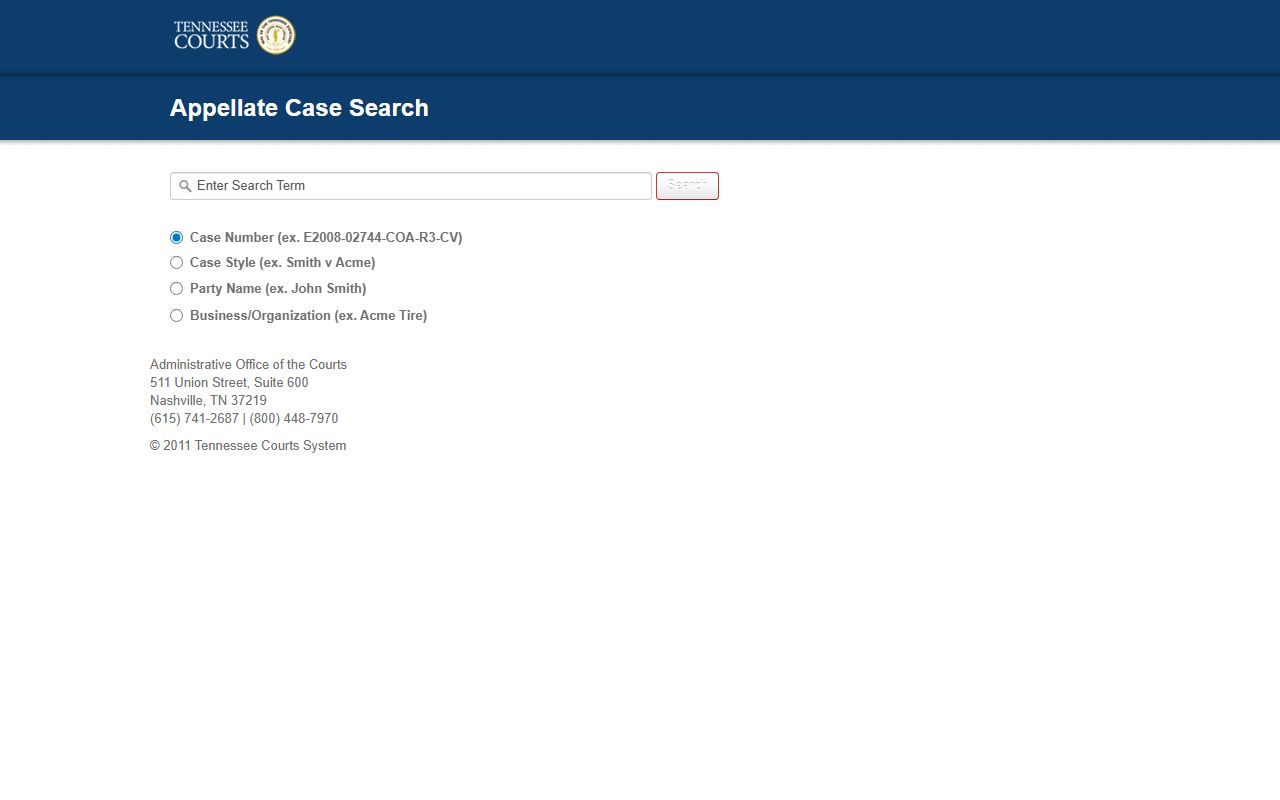
That portal returns appellate case number, title, court, filing date, status, and event history. It will not show a full Williamson County trial-court docket, so pair it with a clerk request for local files.
Note: Always confirm case details with the clerk that holds the file before you rely on online data for a legal or financial decision.
History of Williamson County Courts
Williamson County was created in 1799, and Franklin has served as the county seat since the start. The local court system reflects Tennessee's long split between law and equity, which is why a Circuit Court and a Chancery Court both sit here. The Clerk and Master grew out of that chancery tradition and still keeps probate and equity records today.
Over time, General Sessions Court became the busy front door for misdemeanors, traffic, and small civil cases. Juvenile Court developed as a separate, confidential jurisdiction. Modern updates include e-filing, statewide court forms, online self-help, and appellate case history access. The historic courthouse on the square remains a landmark, but court errands now point to the Judicial Center.
Frequently Asked Questions
How do I search Williamson County court records?
Start by naming the court. Circuit, General Sessions, and Juvenile records tie to the Circuit Court Clerk. Chancery and probate records tie to the Clerk and Master. Marriage records tie to the County Clerk. No open countywide trial-court portal was located, so the safest route is to contact the clerk that holds the file with the party names, the case number if known, the filing year, and the record type.
Where is the main courthouse?
The main court-record destination is the Williamson County Judicial Center at 135 4th Avenue South in Franklin. Circuit Court, Chancery Court, General Sessions Court, Juvenile Court, and clerk services are all centered there. Use that exact address for mapping, and allow time for downtown parking and security screening at the entrance.
Which court handles probate in Williamson County?
Probate runs through Chancery Court and the Clerk and Master. Tennessee does not use a Surrogate's Court or an Orphans' Court. Estates, wills, letters, inventories, guardianships, conservatorships, and trusts are handled there. Request probate records from the Clerk and Master using the decedent or estate name and the case number when you have it.
More on the Williamson County Court Records FAQ page.