
How to Search Williamson County Court Records
Start with the case type, because that tells you the court. Circuit Court takes felony, major civil, and domestic cases. General Sessions handles misdemeanors, traffic, civil warrants, and detainers. Chancery Court, through the Clerk and Master, handles probate and equity. Juvenile Court matters are restricted. There is no open countywide trial-court search portal, so most requests go straight to the clerk that keeps the file.
Gather your facts before you call or visit. You will need the party names, the rough filing year, the case type, and the case number if you have it. Decide whether you want a quick docket check, an in-person file inspection, a plain copy, or a certified copy. Each one is handled a little differently.
- Identify the case type and match it to Circuit, General Sessions, Chancery, or Juvenile court.
- For appellate cases, search the Tennessee Public Case History portal by party name or case number.
- For trial-court files, contact the Circuit Court Clerk or the Clerk and Master.
- Give the clerk the names, filing year, case type, and case number, and state what copy you need.
- Ask whether the file is active, archived, sealed, or expunged, and confirm any fee before paying.
Many county forms and fee documents live in one place online. The Williamson County document center hosts downloadable county forms and schedules that help before a clerk visit.
Use that document center to grab forms ahead of time, since arriving prepared cuts down on repeat trips. It does not replace the clerk, but it saves steps.
Williamson County Court Records Search Fields
The one searchable state system that touches Williamson County cases is the Tennessee appellate Public Case History portal. It covers appellate case history, not local trial dockets, but it shows how a court search screen is built. The fields below come from that portal.
| Field Label | Type | Required | Notes / Format |
|---|---|---|---|
| Search | Text | Yes for keyword | Search by party or case terms. |
| Case Number | Text | No | Tennessee appellate case-number format. |
| Party Name | Text | No | Use last name or organization name. |
| Court | Dropdown | No | Supreme Court, Court of Appeals, or Court of Criminal Appeals. |
| Search / Reset | Button | n/a | Runs or clears the query. |
For trial-court files, there is no public field search like this. You give the clerk the same identifiers by phone, mail, or counter request, and the clerk runs the lookup in the office case-management system.
Types of Williamson County Court Records
Court records here split into a few main groups, and each group is tied to a court. Most adult civil and criminal files are public unless a statute or order limits them. The court that created the record is the office that keeps it.
Filing rules shape what enters a record. The Tennessee Rules of Criminal Procedure govern how criminal documents are filed and served, which explains the chain of entries you see on a docket. You can read the filing rule on the Tennessee Rule of Criminal Procedure 49 page.
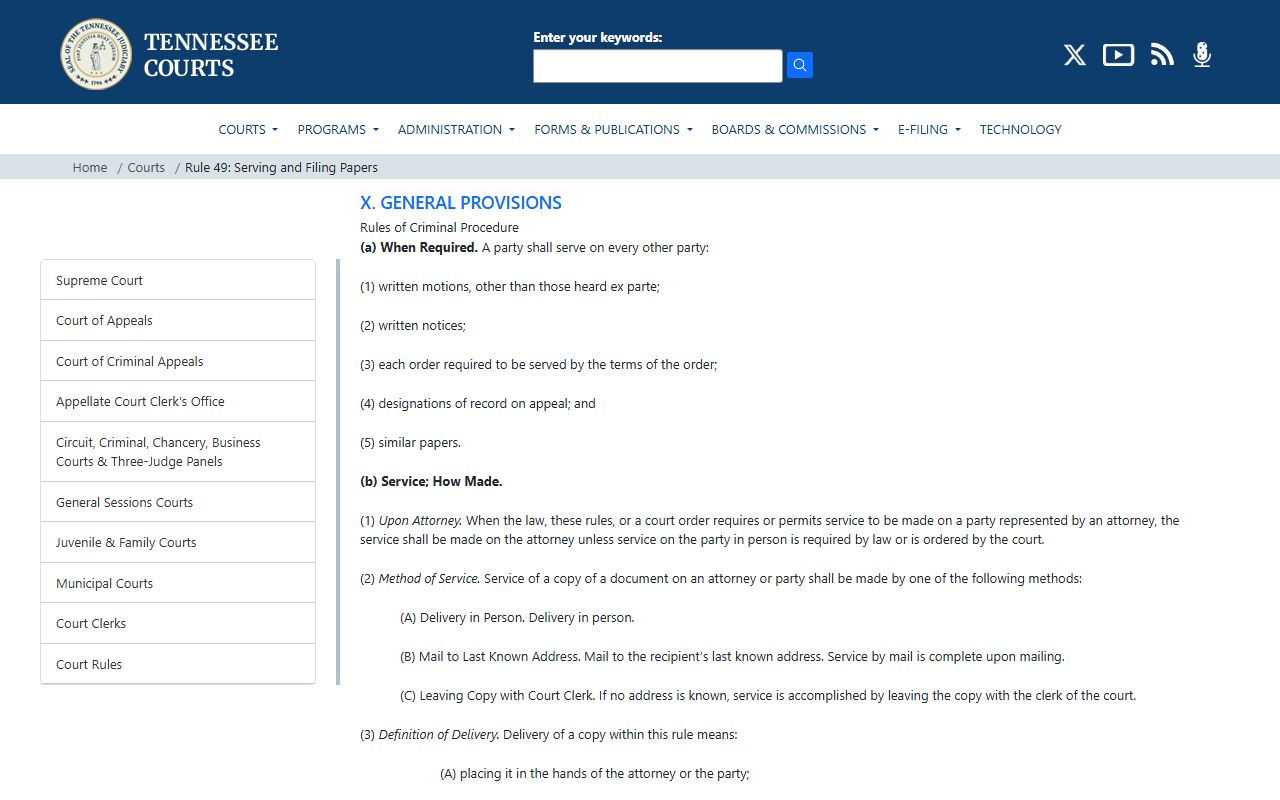
That rule is why each motion, order, and notice shows up as its own dated entry. The list below sorts the common record types.
- Criminal case files: warrants, indictments, pleas, judgments, and sentencing orders.
- Civil case files: complaints, answers, motions, and money judgments.
- General Sessions records: civil warrants, detainers, garnishments, and small claims.
- Family records: divorce decrees, parenting plans, and support orders.
- Probate and equity files: wills, letters, inventories, and trust matters.
Which Clerk Holds Your Williamson County Record
Tennessee splits clerk duties, and Williamson County follows that pattern. The Circuit Court Clerk is the records office for Circuit Court, General Sessions Court, and Juvenile Court. The Clerk and Master is the Chancery Court clerk and keeps probate, estate, trust, and equity files. The County Clerk is a separate office that handles marriage licenses and other county business, not trial-court case files. The term "Clerk and Master" is Tennessee-specific; it simply means the clerk for the equity court. Picking the right office at the start saves a wasted call.
If you are not sure where a case lives, name the case type first. A felony or divorce points to Circuit Court. A small civil claim, eviction, or misdemeanor points to General Sessions. An estate, will, conservatorship, or trust points to the Clerk and Master. A city traffic ticket may sit in a municipal court instead. Once the case type is clear, the clerk is easy to pick.
- Confirm the matter is not Chancery, probate, or a city case.
- Gather the party name, case number, filing year, and charge or claim type.
- Decide if you want docket information, a plain copy, a certified copy, or file inspection.
- Contact the correct clerk through the official county page or visit the Judicial Center.
- Ask whether the file is active, archived, sealed, expunged, or otherwise restricted.
- Confirm current copy and certification fees and the accepted payment methods.
For mailed requests, include a return address, a phone or email, and an exact description of the document you want.
What Williamson County Court Records Show
A court record is built from standard fields. A docket gives the case identity and the chain of events. The full file adds the documents themselves where they are public. Booking and custody data is a separate system from the court file, so a person in jail may have a booking record and a court record that read differently. The table below covers the core fields.
| Field | What It Shows |
|---|---|
| Case Number | The clerk's unique ID; cite it in every later request. |
| Filing Date | When the case began in that court. |
| Parties | Plaintiff and defendant, State and defendant, or petitioner and respondent. |
| Disposition | The final result for a charge or claim. |
Custody and money matters connect to a case but live elsewhere. For someone in the jail, phone-account funding runs through a vendor; you can fund a line at cpcjail.com or by phone. That is not a court record, and the full custody picture is on the inmate records page.

The takeaway is simple. A court record shows charges, hearings, and orders. A jail or vendor system shows custody and account data. Keep the two straight when you research a person.
Public Access Framework for Williamson County Court Records
Two layers control access. The Tennessee Public Records Act gives the public a right to inspect open records held by a government office, set out in Tennessee Code § 10-7-503. Court files add a second layer through Tennessee Supreme Court Rule 34, which defines court records and the rules for sealing. A docket can be public while a single document inside it is not.
Anyone may ask, and you do not need a reason to inspect an open record. Clerks can charge for copies and for staff time to produce them under Tennessee Code § 10-7-506. Bring a photo ID for certified copies and have your case details ready. If a record is confidential by statute, the clerk cannot hand it over just because you ask.
Note: A public docket entry does not promise public access to the document behind it; sealed and confidential filings stay restricted by law.
Records That Are Sealed or Confidential in Williamson County
Several categories are closed or limited. Juvenile records are confidential under Tennessee Code § 37-1-153. Adoption and mental-health files have their own protections. Expunged records are removed from public systems by court order. Sealed records stay closed until a judge unseals them. Grand jury work is secret. Public copies also drop personal identifiers like Social Security and account numbers.
To view a sealed file, you usually file a motion in the court that sealed it and show a legal reason. The judge rules on the request. Expunction runs the other direction: an eligible person petitions the criminal court, and a granted order tells the clerk and agencies to remove the record. The arrest records page covers expunction in more detail.
In-Person Court Record Requests
The clerk counters sit inside the Williamson County Judicial Center in downtown Franklin. Bring a photo ID, the case number if you have it, and payment for any copies. For Circuit, General Sessions, and Juvenile files, start with the Circuit Court Clerk. For probate and Chancery, use the Clerk and Master. Allow time for downtown parking and security screening.
Williamson County Circuit Court Clerk
Williamson County Judicial Center
135 4th Avenue South
Franklin, TN 37064
Mail and phone requests work too. By mail, send the clerk a written request with the case number, party names, filing year, the document you want, and your return contact details. Ask about copy and certification charges before you send payment, since amounts come from the clerk's current schedule. Older files may be paper, microfilmed, or archived, so allow extra retrieval time. A plain copy and a certified copy are not the same thing, and a certified copy is the one most courts and agencies accept for legal use.