
Chancery Court Probate in Williamson County
Chancery Court is the equity court in Tennessee, and probate is one of the case types it handles. In Williamson County, the Clerk and Master is the office that supports Chancery Court and keeps the probate files. The Tennessee Administrative Office of the Courts states that most probate and estate matters are handled by the Clerk and Master in the county, which matches the local Williamson structure.
This is different from states that have a separately named probate court. In Tennessee, the same court that handles equity, injunctions, trusts, and certain civil disputes also handles probate. The Clerk and Master accepts filings, maintains the case file, issues fiduciary letters, schedules hearings, and produces certified copies. The office is the public contact point for almost every step of an estate or guardianship in Williamson County, and it is not the same as the Circuit Court Clerk or the County Clerk.
Common Probate Terms
Probate uses words that do not come up in everyday conversation. Knowing a few core terms makes the rest of the process easier to follow. The definitions below cover the basics.
- Testator
- The person who made a will.
- Executor
- The person named in a will to settle the estate.
- Intestate
- Dying without a valid will, so state law sets the heirs.
- Letters Testamentary
- The court-issued authority for an executor to act.
- Conservator
- A person the court appoints to manage an incapacitated adult's affairs.
- Guardian
- A person the court appoints, often for a minor or protected person.
Other terms come up too, such as inventory, accounting, and creditor notice. The Clerk and Master can identify what a specific filing is called, though the clerk cannot give legal advice on how to handle an estate.
Records a Williamson County Probate File Holds
A probate file collects every step of the estate process. Some documents are routine, like a death certificate or a petition. Others come from later events, like creditor claims or a final closing order. The list below covers the typical documents you will see across the life of a probate case.
- Petition to probate a will or to administer an intestate estate.
- Death certificate or proof of death.
- Original will, codicil, or affidavit about a lost will.
- Order admitting the will or appointing a fiduciary.
- Letters testamentary or letters of administration.
- Inventory of estate assets.
- Notice to creditors and any claims filed.
- Accountings and the final order closing the estate.
- Guardianship or conservatorship petitions, physician reports, and orders.
Many of these documents are public. Some carry restricted material, especially medical reports tied to conservatorship and guardianship cases. Adult adoption matters and certain mental-health filings also follow stricter confidentiality rules.
Estate Filing Steps in Williamson County
Opening an estate follows a set order. The exact path depends on whether there is a will, the size of the estate, and whether a simplified Tennessee process is available. The steps below outline the typical path through Chancery Court and the Clerk and Master.
- Identify whether the decedent had a will.
- Decide whether the estate qualifies for a simplified or small-estate process or requires full administration.
- Prepare the petition and supporting documents for Chancery Court.
- File the original will if one exists.
- Pay the filing fee or request a waiver if legally available.
- Attend any required hearing.
- Receive fiduciary letters from the Clerk and Master.
- Give creditor notice and publish notice where required.
- Inventory and manage estate assets.
- Resolve claims, taxes, debts, and distributions.
- File accounting and closing documents.
- Obtain the final discharge or closing order.
Smaller estates may move faster under Tennessee's simplified rules. Larger or contested estates can stay open longer. Legal counsel is helpful for anything beyond the simplest matter.
One common surprise is the inventory step. The personal representative must catalog assets and provide an inventory to the court within the time the rules allow. That document drives the accounting later. Banks, brokerages, and other holders may need a certified copy of the letters before they release funds, so order extra certified letters when the case opens to avoid a slow second trip to the clerk.
Closing a Williamson County Estate
An estate does not close on its own. The personal representative collects assets, pays valid debts, files required tax returns, deals with claims, and prepares an accounting. Once those steps are complete, the representative asks the court to approve a final accounting and to discharge the fiduciary. The Clerk and Master records the closing order, which formally ends the case.
Several events can slow a closing. A creditor claim that needs litigation pushes the timeline. A contest over a will or a trust adds hearings. A tax issue can stretch things further. None of those are unusual, and the court is set up to handle them, but each adds time. A simple estate can close in a few months, while a contested estate can take much longer.
After closing, certified copies of the orders and the letters may still be needed for follow-up tasks, such as moving a remaining asset or proving a transfer to a third party. The Clerk and Master can issue these after the case is closed if the requester has the case number and the right document description.
Guardianship and Conservatorship
Not every Chancery Court case starts with a death. Conservatorship petitions ask the court to appoint someone to manage an incapacitated adult's affairs. Guardianship petitions often involve a minor or another protected person. Both require evidence of capacity issues or the need for protection, and both produce court-supervised duties for the appointed person.
These files carry sensitive material. Physician reports, evaluations, and personal data are often restricted. The clerk handles them under stricter access rules than ordinary civil files. Anyone considering a conservatorship or guardianship should expect both procedural steps and ongoing supervision after the appointment.
A conservator usually files an annual accounting that shows how the protected person's money was managed. A guardian for a minor may have to report on the child's care and education. These ongoing duties continue until the court terminates the appointment, the minor reaches majority, or the protected person no longer needs help. Each step generates court paperwork that becomes part of the case file the Clerk and Master keeps.
Probate Record Access
No official open probate case search portal was located for Williamson County in this research. To find a specific probate file, contact the Clerk and Master with the decedent or estate name, the filing year if known, the case number if known, and the document or copy you need. Some hearings may be public while certain attached documents are restricted.
Williamson County Clerk and Master
Williamson County Judicial Center
135 4th Avenue South
Franklin, TN 37064
Older probate files may be archived. Allow extra retrieval time for anything older. For copy and certification details, the Circuit Court Clerk page covers similar process points, though that office is separate from the Clerk and Master.
Federal Context for Estate Matters
Probate is a state matter, not a federal one. Federal courts do not handle probate. Federal estate-related questions usually involve federal taxes, federal benefits, or the federal aspects of a bankruptcy filing. For Williamson County residents, federal civil and criminal cases go to the U.S. District Court for the Middle District of Tennessee.
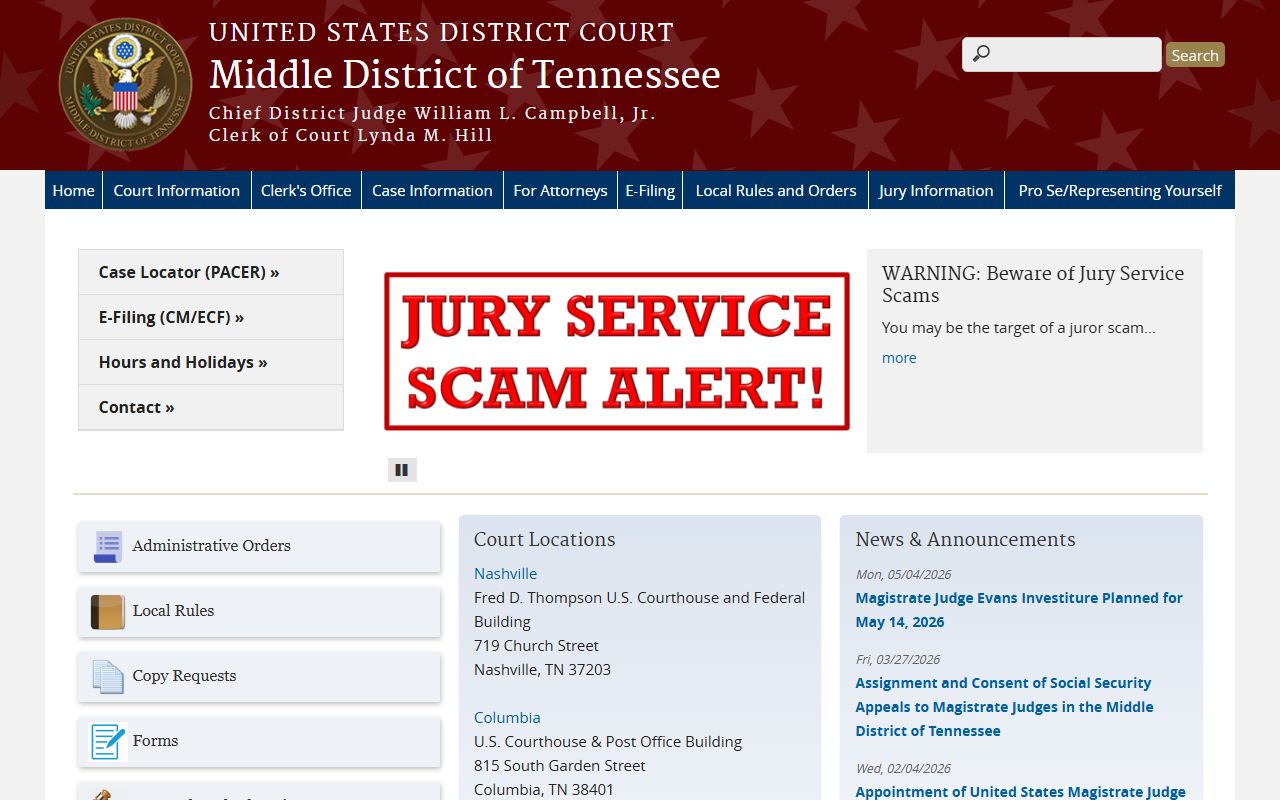
The U.S. District Court for the Middle District of Tennessee handles federal matters. None of those records replace a probate file. The Clerk and Master remains the office for estates, conservatorships, and trusts in Williamson County.
Probate Fees
Probate carries filing, copy, and certification fees. A current Williamson County probate fee schedule was not located in the sources reviewed, so confirm amounts with the Clerk and Master before paying. The table lists the common fee types rather than invented prices.
| Item | What It Covers |
|---|---|
| Filing fee | The cost to open a probate matter; amount set by the clerk's current schedule. |
| Certified copy | A clerk-certified copy of a probate document. |
| Fiduciary letters | The court-issued letters that prove an executor or administrator can act. |
| Publication | Paid to the newspaper or vendor where notice publication is required. |
Note: Letters testamentary and letters of administration are not the same as a full case-file copy; banks and insurers usually want certified letters as proof of authority.
For related searches and offices, see the marriage and divorce records page, the County Clerk page, and the court records page. The Circuit Court page covers how Chancery Court fits with the other Williamson County trial courts.